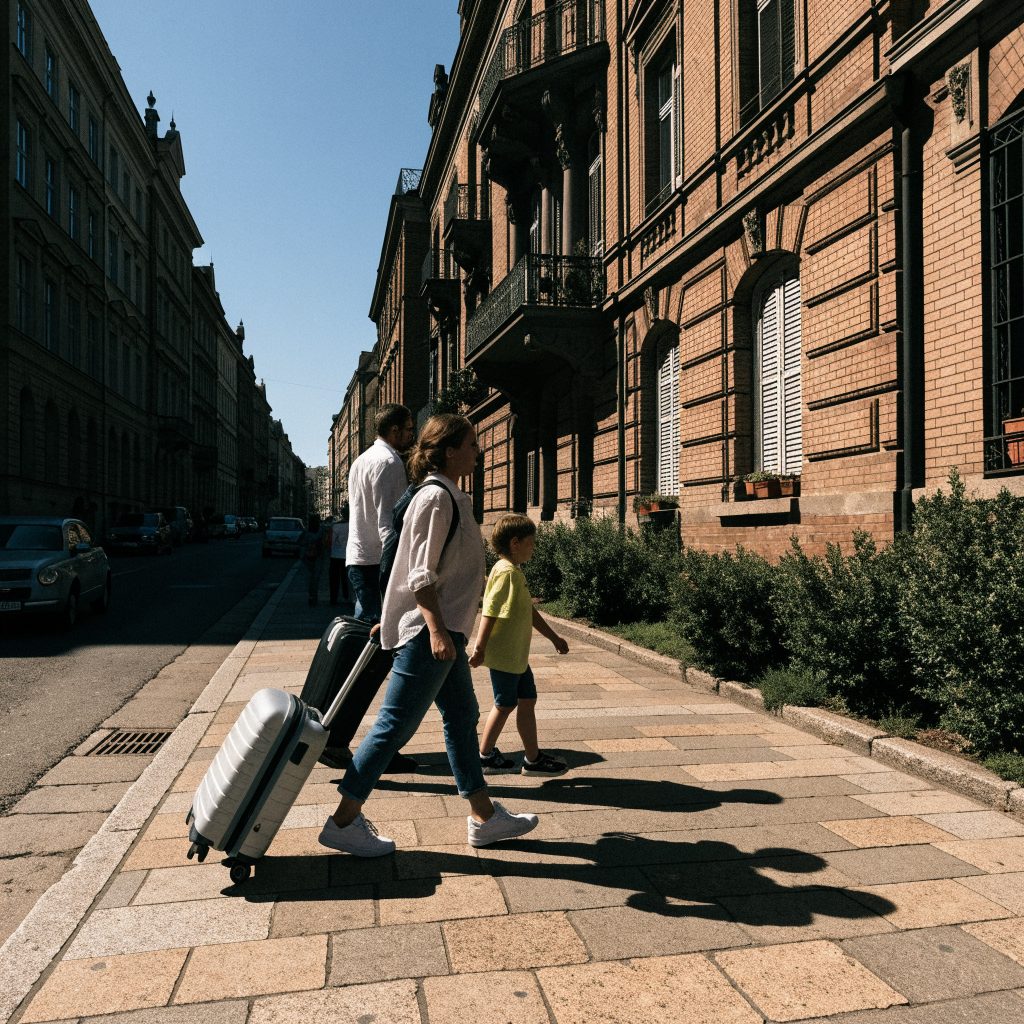
Moving to Poland from the USA with children can make European city life more affordable, but the family budget depends heavily on housing and school choice. We can plan a home around everyday needs, compare free public education with international-school fees, and allow extra time for residence paperwork; this guide to moving to Poland from the USA brings those decisions together.
How can a family plan its move and residence paperwork?
Most families need to plan their residence route around the main applicant’s reason for moving, such as work, study or running a business. Americans can visit Poland without a visa for up to 90 days in any 180-day period, but a longer stay requires the appropriate visa or residence basis.
A National D visa allows stays of more than 90 days and up to one year. A temporary residence permit is tied to a specific purpose, such as a job or study programme, and allows a stay longer than three months. The Karta Pobytu is the residence card that confirms a foreigner’s legal residence.
Since April 2026, residence applications are filed online through the MOS portal, which requires a Polish trusted profile and a PESEL number. The trusted profile is an electronic identity used to access Polish online services, while PESEL is a national identification number needed to obtain it. Because PESEL must be collected in person, families should check the practical sequence with the relevant office before relying on the online process.
Processing can affect plans for a lease, school start and travel. Warsaw’s voivodeship office was reported to take about nine to fourteen months to decide residence cases, so keep copies of applications and confirm the current timeline with the office handling your case. Family members’ permits generally depend on the main applicant’s status, but exact rules for children and accompanying relatives should be verified with the voivodeship office or official Polish government information.
Build flexibility into your first-year plans rather than assuming every family member’s paperwork will be completed at the same time.
How much does family life in Poland cost each month?
Expatsi estimates about $1,600 per month for one person and $2,500 for a couple including rent, while Numbeo gives about 3,087 PLN per month for a single person excluding rent and about 10,397 PLN for a family of four excluding rent. Rent in the city centre is the main variable: about 2,834 PLN for a one-bedroom and 4,690 PLN for a three-bedroom in Numbeo’s averages.
These figures use different household assumptions, so treat them as planning references rather than a single family quote. Numbeo estimates monthly costs for a family of four at about 10,397.1 PLN, or about €2,343, excluding rent. A family with children should add housing, school-related expenses and the costs of settling into a new home.
For a simple worked example, we can combine the average city-centre three-bedroom rent with one child’s international-school tuition. One education-cost guide puts typical annual tuition at around 45,300 PLN, with additional fees potentially adding 10–30 percent; using 3.80 PLN per USD as the exchange rate, the estimated monthly amount for rent and tuition is about 8,843–9,598 PLN, or about $2,327–$2,526. This is a partial budget, not a full family cost estimate: it excludes food, utilities, transport, other children’s fees and one-time school charges.
Use the worked example as a starting point, then add your family’s actual food, transport, utilities and school choices. A stronger zloty can raise the dollar cost of a Polish budget, while a weaker zloty can reduce it; the exchange-rate assumptions used by cost guides are not constant, so check the current rate when planning transfers.
This table shows how the major housing and education figures can fit together for a family considering a central three-bedroom flat and one international-school place.
| Planning item | Amount | How to interpret it |
|---|---|---|
| Three-bedroom city-centre rent | 4,690.41 PLN per month | Numbeo average |
| International-school tuition | 45,300 PLN per year | Typical annual tuition reported by an education-cost guide |
| Tuition with estimated additional fees | About 4,153–4,908 PLN per month | Annual tuition divided by 12, with 10–30 percent added |
| Rent plus tuition with estimated additional fees | About 8,843–9,598 PLN per month | Partial budget; excludes other living costs |
| USD equivalent for the combined amount | About $2,327–$2,526 per month | Calculated at 3.80 PLN per USD |
Does Poland cost less than the United States?
Yes, typical cost comparisons put Poland below the United States overall, although the size of the gap depends on the method and location used. MyLifeElsewhere puts Poland at 45.2% cheaper overall in 2026, while the cost advantage may feel different to a family earning a local Polish salary rather than a US income.
The wage comparison matters. Expatsi reports an enterprise-sector average gross monthly wage of 9,509 PLN and a median of 7,691 PLN in 2026; the stated statutory minimum is 4,806 PLN gross per month. Gross pay is not take-home pay, and household costs vary with city, rent and school fees.
Poland uses the Polish zloty, or PLN, and is in the EU but not the eurozone. Most goods carry a 23% VAT rate, which is included in shelf prices. For commuting, a monthly local transport pass is listed at about 32.28 USD, while gasoline is about 1.70 USD per litre.
Compare your expected take-home income with your complete monthly budget, not just with headline prices in the two countries. For employment, families can look for openings through major job boards and confirm work-permit requirements before accepting a role. Self-employment is a separate route: US citizens may register a Polish sole proprietorship under a treaty signed in Washington in March 1990, without first holding a residence card. The social insurance institution, ZUS, can cost about 1,788 PLN per month after the initial six-month start relief known as ulga na start, which waives social contributions but leaves the health contribution.
Which school option works best for children?
Public schools in Poland are tuition-free for children, including foreign residents, while an international school typically costs around 45,300 PLN per year. Families choosing international education should also budget for additional charges, which can add 10–30 percent to base tuition.
Public school can make the move more affordable and support children’s Polish-language learning. Enrollment is commonly connected to the family’s local area, so contact the relevant school or local authority early to check catchment arrangements, documents and available places. The compulsory free pre-primary year for six-year-olds is another detail to confirm when planning a child’s transition.
School lunches typically cost 12–20 PLN per meal. After-school care, called świetlica, is arranged separately from tuition, so ask the school what hours it offers and whether there are charges. A nearby bar mleczny, a budget canteen serving inexpensive Polish meals, can also be useful for occasional low-cost lunches.
Private Polish-language and bilingual schools in Warsaw charge from 700 to 3,300 PLN per month, with many around 1,000–1,100 PLN monthly. International-school tuition varies by school and curriculum, and enrollment fees, uniforms and bus transport can add to the bill.
Before choosing a school, compare the full annual cost and the daily journey from the home you are considering. Families who rent before school admission may want to avoid committing to a long commute until they know where a child can enroll.
How can we make a Polish home feel settled quickly?
Start with a home layout that makes everyday routines easier: create a clear landing area for coats and school bags, keep a simple homework spot near good light, and use flexible storage while you learn what the apartment provides. These modest choices can help a family feel at home before every box is unpacked.
Warsaw and Kraków offer extensive cultural life and modern infrastructure, while public transport can reduce the need to rely on a car. Families should also expect a period of language adjustment: learning useful Polish phrases can make school conversations, appointments and errands less daunting, even if the children attend an English-language programme.
Safety and healthcare are part of the wider comparison. The World Bank recorded a homicide rate of 0.8 per 100,000 people per year in Poland, compared with 5.8 in the United States in 2023. This national indicator is not a guarantee about any individual neighbourhood, so visit prospective areas and consider the route to school, shops and transport.
Choose a neighbourhood by the routines your family will repeat every day, rather than by a short list of tourist landmarks.
What should families do before booking the move?
A little sequencing can prevent avoidable pressure: check the residence route, school options and housing area together, then build a budget that includes the costs that are easy to overlook.
- Confirm the appropriate visa or residence basis for the main applicant and ask how children and other accompanying family members should apply.
- Check current application procedures, required documents and decision times with the relevant Polish authorities.
- Contact schools about catchment rules, places, language support, meals, after-school care and the full fee schedule.
- Compare rent with the daily school and work journey, and include utilities, transport, groceries and school extras in the monthly plan.
- Recalculate any USD-based budget using the exchange rate available when you will transfer or spend the money.
Sources
- Moving to Poland from USA: Everything you need to know (wise.com)
- Education costs in Poland (myhabroad.com)
- Moving to Poland from the US: Visas & Cost of Living (expatsi.com)
- Moving from the United States to Poland (mylifeelsewhere.com)
- Cost of Living in Poland (numbeo.com)